

Every person who has ever watched you present has scored you. Instantly, unconsciously, and permanently. Your board scored you at the last meeting. Your team scored you at the town hall. The only thing that's ever been missing is somebody telling you the number — and which two or three things are quietly costing you the most.
That's what the Professional Presence Index is for.
Everyone Has a Number.
Nobody’s Told You Yours.
Get Your Score
See How It Works
See the Outcomes
The Problem
This Isn’t About the Suit
When people hear "executive presence," they picture image consulting: better posture, a sharper jacket, a firmer handshake. Something adjacent to the real work.
It isn't. It's a P&L issue, and there are numbers to prove it.
Research on workplace communication puts the cost of poor communication in the trillions of dollars annually across U.S. businesses, and separate studies tie communication breakdowns to a significant share of delayed or failed corporate projects. The estimates vary by methodology, but the direction never does. This is a large number, it lands on the balance sheet, and almost no organization manages it on purpose.
Here's the number worth remembering: companies led by strong communicators have been shown to deliver dramatically higher returns to shareholders over time. Not on a soft-skills survey. To shareholders.
The gap between what a leader knows and how a leader lands has a dollar value. Most leaders have simply never been shown the invoice.

The Reframe
Your EQ Was One Step. Your Professional Presence Index Comes Next
Thirty years ago, nobody in a boardroom said "emotional intelligence." Then someone made it measurable, and within a decade it was standard in every serious leadership assessment in the country.
Your EQ is what you perceive.
Your Professional Presence Index is How you’re perceived.
EQ tells you how well you read the room. Profession Presence Index tells you how the room reads you. They are not the same skill and plenty of leaders are strong in one and quietly weak in the other.
If your organization has spent fifteen years assessing emotional intelligence and never once measured how its leaders actually land, that's not a strike against EQ. It just means you've only been running the diagnostic on half the system.

The Framework
One Score. Twenty Metrics. Five Sections.
"You need more executive presence" is the least useful piece of feedback a leader can receive — true, and completely unactionable. So we broke it down.
The Professional Presence Index scores twenty distinct metrics, each rated 1–10, averaged into a single number: your PPI.
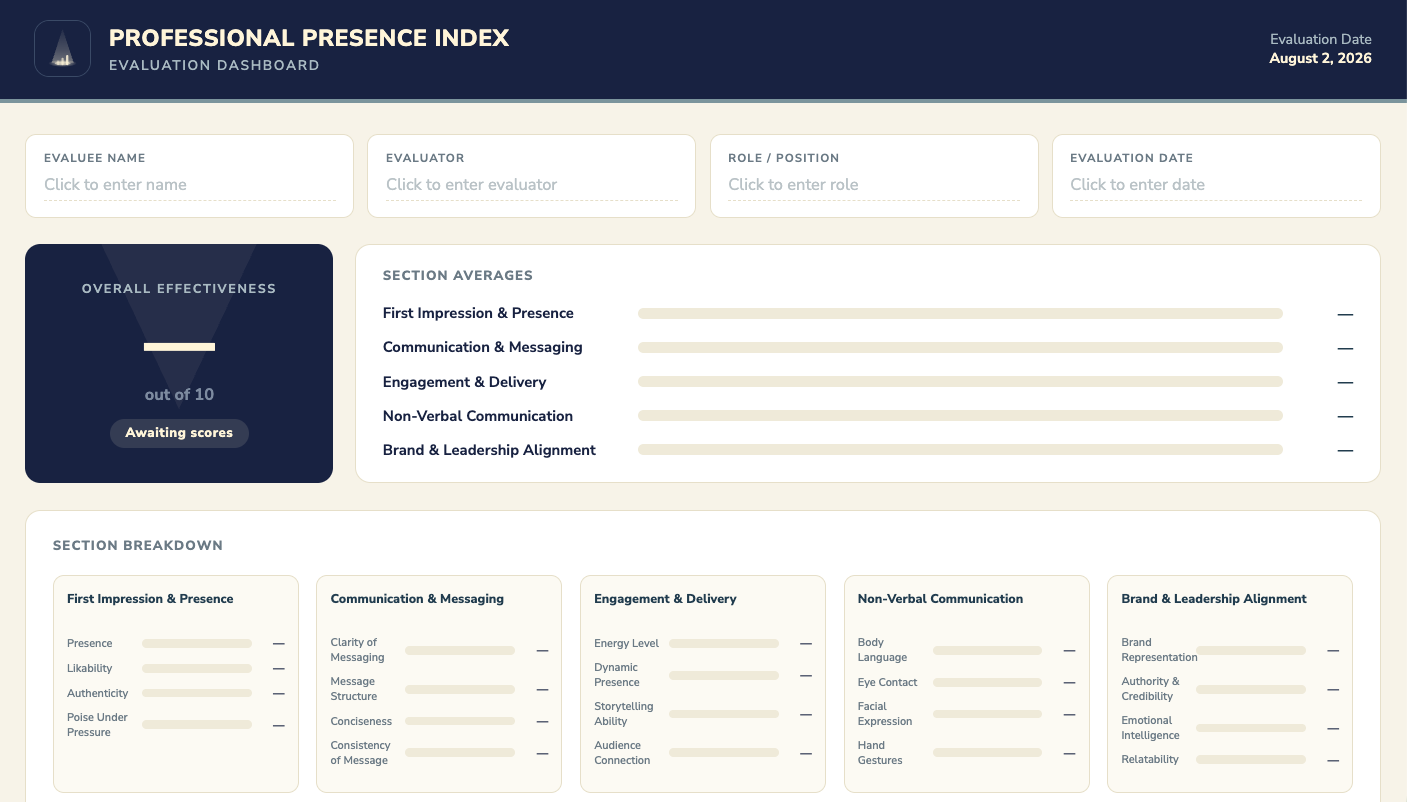
First Impression & Presence — Presence, Likability, Authenticity, Poise Under Pressure
Communication & Messaging — Clarity, Structure, Conciseness, Consistency
Engagement & Delivery — Energy, Dynamic Presence, Storytelling, Audience Connection
Non-Verbal Communication — Body Language, Eye Contact, Facial Expression, Hand Gestures
Brand & Leadership Alignment — Brand Representation, Authority & Credibility, Emotional Intelligence, Relatability

How It Works
Three Ways to Get Your Number
They differ in exactly one respect: how honest the result is.
1. Score yourself. Use our free self-assessment. Twenty minutes, twenty metrics. It's biased, you'll be too generous in some places and too hard on yourself in others, but even an imperfect baseline beats no baseline at all.
2. Have someone you trust score you. Hand the same sheet to a colleague or coach, along with a short video. Better than scoring yourself, because they can actually see you.
3. Get scored by the panel. This is the real number. Submit short videos and a panel of vetted communication experts, broadcasters, executive coaches, communications professors, scores all twenty metrics independently and blind to one another. Nobody on the panel knows you, likes you, or reports to you. That's the point.
However you get your score, the instruction is the same: find your two or three lowest metrics, and start there. Ignore the other seventeen for now.
WHY QUARTERLY
Presence Work Is Invisible From the Inside.
You won't feel yourself improving. You'll feel self-conscious and convinced it isn't working, right up until the number moves.
Most clients re-score every ninety days: four evaluations a year, two or three metrics worked at a time. A motivated leader who focuses on a small number of metrics typically moves 1.5–3 points in a year. Nobody moves all twenty at once. They move two or three, several times over.
Let’s Get Your Number
Here,You've spent your entire career being measured on everything except this. Your product knowledge, your margins, your safety record, your quarterly numbers — all tracked, all benchmarked, all coached.
The way you're perceived in the room where it counts never was. Until now.

WORK WITH US